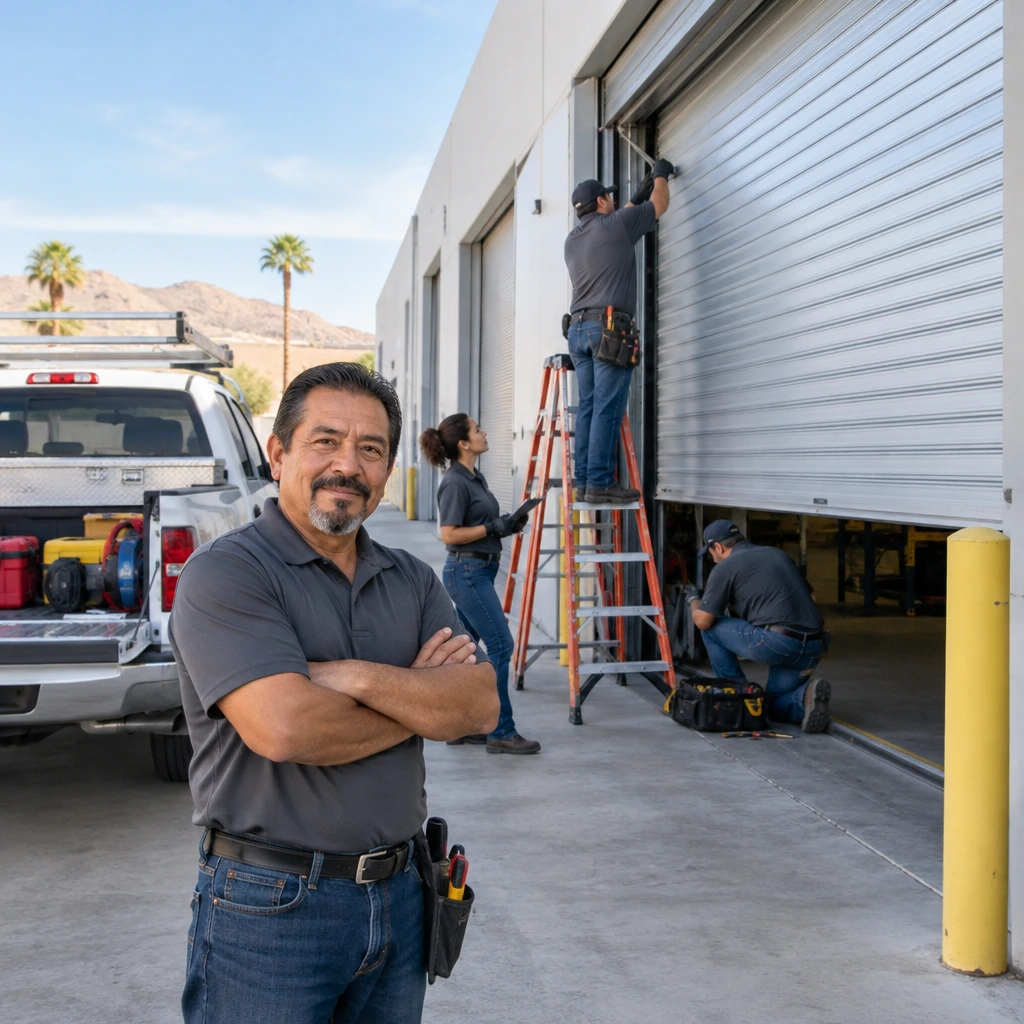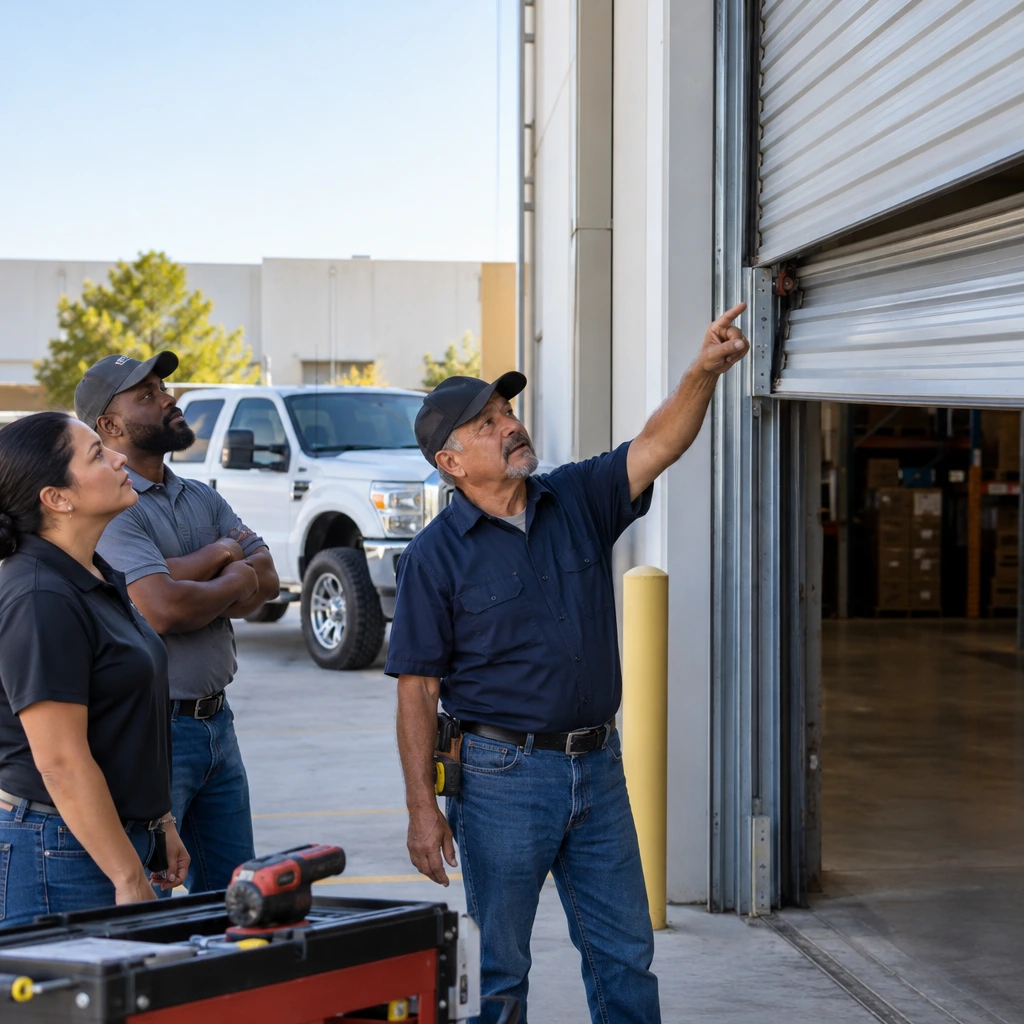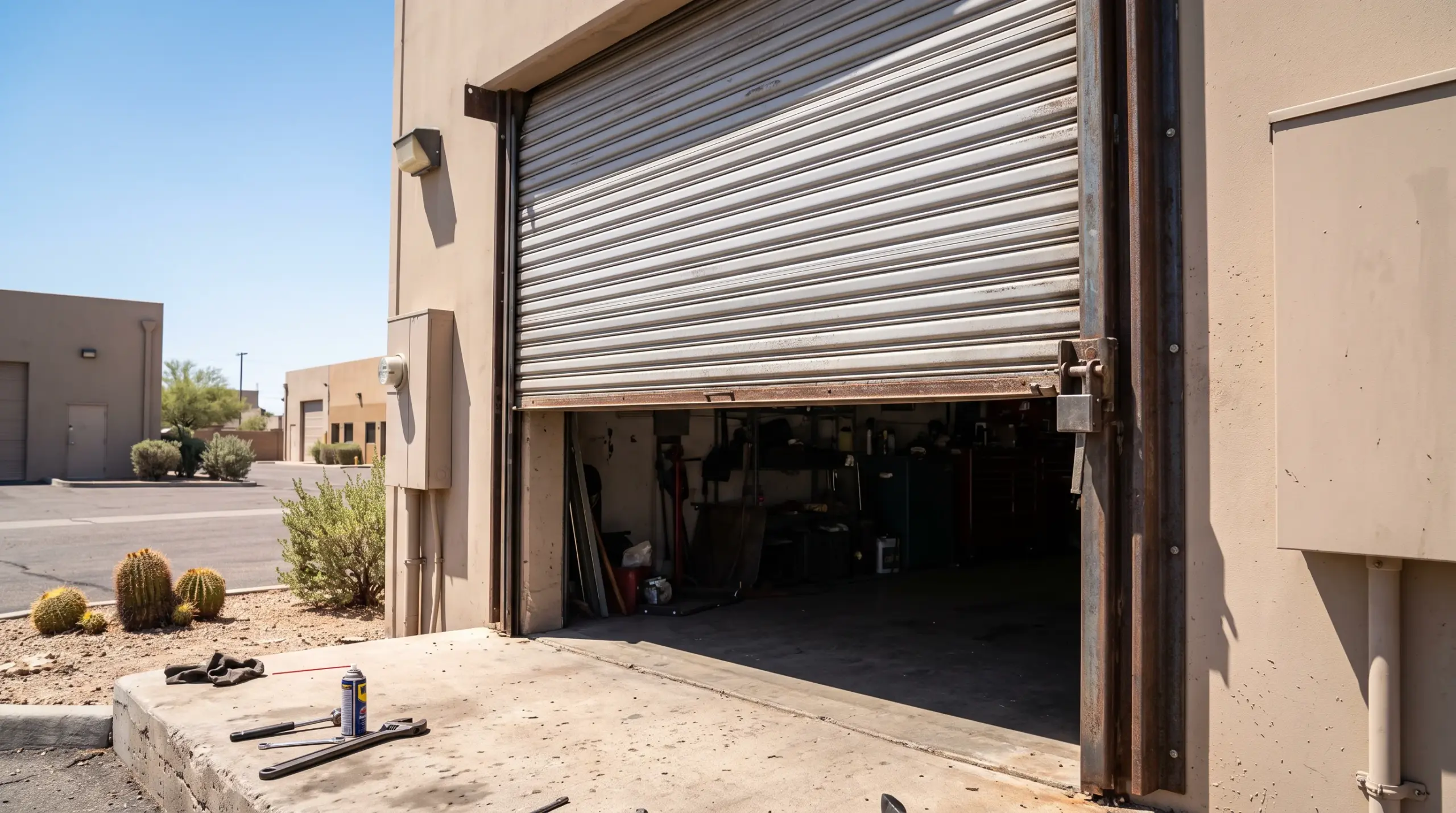
Understanding the roll-up door lifespan in Maricopa County can help property owners avoid emergency downtime, protect inventory, and plan replacement costs more intelligently. A commercial roll-up door may continue operating for many years, but its actual service life depends on usage frequency, installation quality, maintenance, exposure to heat and dust, and the condition of its springs, cables, tracks, panels, motor, and safety equipment. In Phoenix, Avondale, Buckeye, Goodyear, Scottsdale, and North Phoenix, local weather adds another layer of wear. This guide explains how long a roll-up door may last, which warning signs usually justify repair, when replacement becomes the better investment, and how professional door maintenance in Maricopa County can extend dependable operation.
Roll-Up Door Lifespan in Maricopa County: What Determines It?
There is no single expiration date for every commercial roll-up door. A lightly used door at a small facility may remain serviceable far longer than a high-cycle door at a warehouse, loading area, or busy service business. As a practical planning guideline, many commercial roll-up doors can provide roughly 15 to 30 years of service when correctly sized, professionally installed, and maintained. However, that range is not a guarantee. A door exposed to constant daily cycles, vehicle impacts, neglected lubrication, or long-term water and dust intrusion may require major repairs much sooner.
Usage is one of the biggest variables
Cycle frequency matters because every opening and closing places stress on the spring or counterbalance system, guides, bearings, cables, operator, and other moving components. A door used five times per day experiences a very different workload from one used dozens or hundreds of times per day. Commercial facilities should evaluate the door based on its expected daily cycles rather than relying only on calendar age.
Installation quality also affects commercial roll-up door durability. Incorrect measurements, poor track alignment, inadequate anchoring, an improperly balanced curtain, or an undersized motor can create friction and vibration throughout the system. Those problems may appear minor at first, but they can accelerate wear across otherwise healthy components.
Climate can shorten the maintenance interval
Maricopa County frequently experiences summer temperatures above 110 degrees Fahrenheit, according to the county’s official monsoon and extreme-heat information. The county also reports that dust storms can occur one to three times per year in the Phoenix area. These conditions can push fine particles into tracks, bearings, seals, sensors, and operator components. The result may be sluggish movement, unusual noise, premature corrosion on vulnerable hardware, or unreliable safety equipment.
For that reason, a door’s age should be considered alongside its operating condition. A well-maintained 20-year-old door may be a better repair candidate than a poorly maintained 10-year-old door that has suffered repeated impacts or structural damage.
When Commercial Roll-Up Door Repair Is the Better Choice
Repair is usually the sensible option when the main door curtain, guides, support structure, and operator remain fundamentally sound. Replacing an individual spring, cable assembly, panel, sensor, bearing, track component, or motor can restore safe operation without the cost and disruption of a full replacement.
Common repairable problems
- Sluggish or slow operation: Cleaning, lubrication, track adjustment, spring-tension correction, or motor diagnosis may resolve the issue.
- Broken springs or cables: These components should be replaced by a qualified technician because stored tension can create serious injury hazards.
- Track misalignment: Bent guides, obstructions, loose hardware, or shifting supports may be corrected if the surrounding structure is still stable.
- Motor or opener problems: Electrical connections, controls, limit settings, drive components, or the operator itself may be repaired or replaced.
- Safety sensor faults: Testing and replacement can often restore proper stopping or reversing functions.
- Limited panel damage: A localized dent or impact may be repairable when it does not interfere with balance, travel, security, or the door’s overall alignment.
A repair makes particular sense when the door has received regular maintenance, replacement parts are available, and the estimated repair cost is modest compared with a new installation. It is also valuable when a business needs to minimize downtime. Arizona Roll Up Door Service provides diagnosis, repair, adjustment, and maintenance for commercial and residential roll-up systems throughout the Phoenix metro region, with same-day service when possible.
Safety should come before convenience
Do not continue using a door that drops, binds severely, reverses unpredictably, leaves a large gap, or operates with exposed or damaged lifting components. The U.S. Department of Labor’s OSHA hazard prevention guidance emphasizes regular inspections, effective controls, and routine preventive maintenance to reduce equipment-related incidents. Professional technicians should isolate power and secure the door before working on springs, cables, operators, or other stored-energy components.
When Roll-Up Door Replacement Is the Smarter Investment
Replacement becomes more attractive when repairs are no longer addressing isolated failures but are instead compensating for an aging or structurally compromised system. A door may still open and close while being close to the end of its practical service life. Repeated breakdowns, rising repair bills, and increasing business interruptions are often more meaningful than age alone.
Strong indicators that replacement may be warranted
- The curtain or major sections are severely bent, cracked, distorted, or repeatedly damaged.
- The guides, mounting surfaces, header, or supporting structure are failing or no longer properly aligned.
- The door requires frequent service calls for unrelated problems.
- Replacement parts are obsolete, unavailable, or incompatible with current safety requirements.
- The operator is inefficient, unreliable, or unable to handle the door’s cycle demands.
- The door no longer provides the desired security, weather protection, insulation, or operational speed.
- A repair estimate approaches a substantial portion of a properly specified replacement.
Replacement can also be the right choice when a business is changing how it uses the building. A new tenant, expanded warehouse activity, heavier delivery traffic, or increased cycle count may justify a commercial-grade system designed for the current workload. In that situation, repairing an underpowered or poorly configured door may only postpone the larger expense.
Because the roll-up door replacement cost in Arizona varies widely, a contractor should evaluate opening size, material selection, cycle rating, insulation needs, operator type, access conditions, electrical requirements, removal of the existing door, and installation labor. A low initial quote may not represent the best value if it excludes important upgrades or is not designed for the facility’s daily demands.
Repair versus replacement: a practical comparison
Choose repair when the main structure is sound and the problem is limited to serviceable components. Choose replacement when the door is unsafe, repeatedly failing, severely damaged, obsolete, or mismatched to the building’s current needs. A professional inspection should include the curtain, guides, brackets, springs, cables, operator, controls, sensors, mounting points, and surrounding wall structure—not just the symptom reported by the customer.
Why Maricopa County Conditions Matter for Door Service Life
Local conditions are especially relevant when estimating the roll-up door lifespan in Maricopa County. The county identifies extreme heat, dust storms, monsoon storms, and flooding among its common natural hazards. Its official Maricopa County monsoon guidance notes that intense summer rains can produce flash flooding, while thunderstorms may create sudden dust storms or “haboobs.”
For commercial properties, these events can affect roll-up doors in several ways. Windblown dust can collect in tracks and around moving hardware. Heavy rain may expose worn bottom seals, damaged weather protection, or drainage problems. Sudden winds can carry debris into the opening or cause impact damage. Extreme heat can also increase the demands on electrical components and may make neglected lubrication less effective.
A local example: Phoenix-area loading and service openings
Consider a distribution facility in West Phoenix, Buckeye, or Goodyear that operates a large roll-up door throughout the day. The door may face frequent cycles, airborne dust from nearby roads or undeveloped land, and seasonal monsoon debris. A maintenance plan for that facility should be more proactive than a plan for a lightly used door at a climate-controlled property.
Maricopa County’s air-quality information explains that dust storms can produce very high PM10 concentrations and that conditions can change rapidly. Its air-quality monitoring guidance is a useful reminder that dust events are not merely a visibility concern; they can also signal conditions that require closer attention to exposed mechanical equipment.
After a major dust event, property managers should check for debris in the guides, unusual scraping, slower travel, sensor contamination, and damage to seals or panels. After a severe storm, they should also look for water intrusion, impact marks, loose fasteners, and changes in alignment.
How Preventive Maintenance Extends Roll-Up Door Life
Preventive maintenance is one of the most effective ways to improve reliability and control long-term repair costs. A maintenance visit should be more comprehensive than spraying lubricant on visible hinges. It should evaluate the complete operating system and identify small problems before they become emergency failures.
Recommended maintenance checklist
- Inspect springs, cables, brackets, bearings, guides, panels, and fasteners.
- Clean tracks and remove dust, debris, and obstructions.
- Lubricate appropriate moving parts according to manufacturer recommendations.
- Check balance, travel speed, alignment, and unusual vibration or noise.
- Test motors, limit settings, controls, and emergency release functions.
- Inspect safety sensors, photo eyes, reversing action, and stopping performance.
- Examine bottom seals and perimeter protection for gaps or deterioration.
- Document wear, recommended repairs, and future replacement planning.
The ideal schedule depends on door usage and exposure. A high-cycle commercial opening may need quarterly or more frequent service, while a lightly used system may be inspected less often. Businesses in Maricopa County should consider additional checks before and after the most active monsoon period and after significant dust or wind events.
Regular service also helps owners budget more intelligently. Instead of waiting for a spring failure or a door stuck open during business hours, managers can plan component replacement, compare repair and replacement options, and schedule work during a lower-impact period. Arizona Roll Up Door Service offers customized maintenance schedules, safety testing, hardware adjustments, track cleaning, spring and cable inspections, and performance optimization throughout the Phoenix metro area.
Conclusion: Get a Professional Repair-or-Replace Assessment
Determining whether to repair or replace a roll-up door requires more than counting its years. Usage, structural condition, operating safety, maintenance history, climate exposure, and repair frequency all affect the decision. In Maricopa County, extreme heat, airborne dust, monsoon storms, and heavy commercial usage can shorten maintenance intervals and reveal weaknesses sooner.
If your door is slow, noisy, unbalanced, damaged, or repeatedly breaking down, schedule an inspection before a minor issue becomes a shutdown. Arizona Roll Up Door Service has over 20 years of experience providing expert installation, repair, and maintenance for businesses throughout Phoenix, Avondale, Buckeye, Goodyear, Scottsdale, North Phoenix, and surrounding communities. Contact Arizona Roll Up Door Service today for a free consultation and get a clear recommendation based on safety, condition, expected service life, and long-term value.