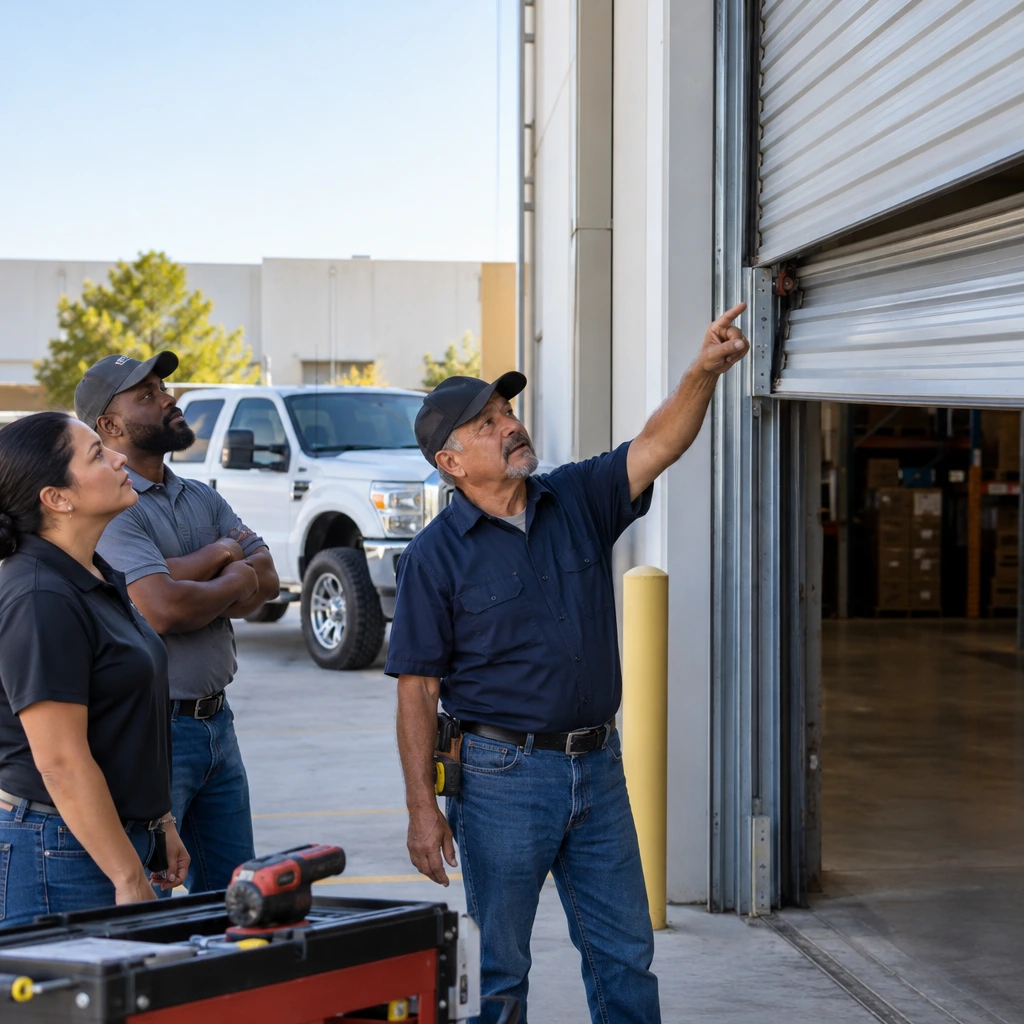
Every morning, thousands of Phoenix business owners press a button or pull a chain expecting their roll-up door to glide smoothly open. But when that door jerks, grinds, or simply refuses to budge, the workday comes to a screeching halt. Loading docks sit idle. Deliveries stack up. Customers wait. The culprit? More often than not, your roll-up door has jumped its track or suffered a misalignment that’s now threatening to strand your entire operation.
Off-track problems don’t announce themselves with flashing lights. They creep in gradually—a slight hesitation here, an unusual scraping sound there—until one day your door won’t move at all. The good news is that you can spot the warning signs early, before a minor tracking issue escalates into a costly emergency repair or a complete operational shutdown. In this guide, we’ll walk you through the telltale symptoms of track problems, explain what causes roll-up doors to derail in Phoenix’s demanding climate, and show you exactly when to call for professional help.
Understanding Roll-Up Door Track Systems and Why They Fail
Your commercial roll-up door relies on a precisely engineered track system to guide the curtain up and down thousands of times each year. The vertical guides on either side of the opening hold the curtain’s edges, while the barrel at the top winds and unwinds the slats or panels. When everything aligns perfectly, the door operates smoothly and quietly. But Phoenix’s extreme temperature swings, heavy daily use, and the occasional forklift mishap can throw this delicate balance off.
How Track Misalignment Develops Over Time
Track problems rarely happen overnight. According to commercial door repair specialists, misalignment typically develops through a combination of factors: mounting hardware loosens as the building settles, thermal expansion and contraction stress the metal components, and the cumulative effect of thousands of opening cycles gradually shifts the guides out of position. In Phoenix, where summer temperatures routinely exceed 110°F, metal expansion becomes a significant factor that many facility managers underestimate.
Common Causes of Off-Track Failures
Several specific scenarios push roll-up doors off their intended path:
- Impact damage: Forklifts, pallet jacks, or delivery trucks striking the door or guides bend the metal framework and knock the curtain out of alignment
- Worn or damaged slat ends: The edges of individual slats that ride in the guides wear down over time, allowing the curtain to wander or pop out completely
- Bent or pulled guides: Wall-mounted guides can bend, twist, or pull away from their mounting surface, especially if the fasteners were inadequate for the door’s weight
- Debris accumulation: Dirt, dust, and small objects collect in the track channels, creating obstructions that force the curtain off course
- Counterbalance failure: When springs break or lose tension, the unbalanced weight distribution can cause the curtain to bind and derail
Each of these issues creates a cascading effect. What begins as a minor misalignment puts additional stress on other components, accelerating wear and increasing the likelihood of complete failure. Arizona Roll Up Door Service has seen countless cases where a small tracking issue ignored for weeks resulted in damage costing five times more to repair than if addressed immediately.
Five Warning Signs Your Roll-Up Door Is Coming Off Track
The key to preventing a complete off-track failure lies in recognizing the early symptoms. Your roll-up door will tell you something’s wrong—you just need to know what to look for during daily operation.
1. Visible Gaps Between Curtain and Guides
Stand directly in front of your closed roll-up door and examine both sides carefully. The curtain should sit flush within the vertical guides with minimal visible gap. If you notice daylight showing through on one side, or if the curtain appears to be riding closer to the outside edge of the guide channel, the door is beginning to walk out of alignment. This symptom often appears first on the side experiencing the most stress or where a guide has shifted position.
2. Uneven Movement or Hesitation During Operation
A properly functioning roll-up door moves smoothly from bottom to top at a consistent speed. Watch your door through a complete cycle. Does it hesitate at certain points? Does one side appear to lift faster than the other? Industry experts note that slow or jerky movement indicates spring or track problems requiring immediate attention. This uneven motion means the curtain is fighting against misaligned guides or binding on an obstruction, and the problem will only worsen with continued use.
3. Unusual Grinding, Scraping, or Squealing Noises
Roll-up doors should operate relatively quietly, with only minimal mechanical sounds. New or alarming noises signal trouble. A grinding sound typically means metal is rubbing against metal where it shouldn’t—often the curtain scraping against a bent guide or damaged slat ends catching on the track. Squealing suggests either a lack of lubrication or, more seriously, components binding under stress. Don’t dismiss these auditory warnings as normal aging; they’re your door’s way of announcing an impending failure.
4. The Door Stops Mid-Cycle or Refuses to Move
When your roll-up door stops partway through opening or closing, something is physically preventing it from continuing. The curtain may have encountered an obstruction in the guides, a slat may have buckled, or the door may have partially derailed and jammed in place. Never force a stuck door to continue moving—you’ll likely cause additional damage to the curtain, guides, or operating mechanism. As commercial door repair providers warn, a curtain leaving its guides is not a door you should cycle again without professional inspection.
5. Slats Appear Separated or Buckled
Inspect your door’s curtain for visual deformities. Individual slats should interlock uniformly across the entire width of the door. If you see slats that appear separated, pushed out of alignment, or buckled inward or outward, the curtain has experienced stress that’s compromising its structural integrity. This damage often occurs after an impact or when a door with tracking problems was forced to continue operating. The affected area creates a weak point that will fail completely under continued use.
Phoenix-Specific Challenges That Accelerate Track Problems
Operating commercial roll-up doors in the Phoenix metro area presents unique challenges that facility managers in milder climates don’t face. Understanding these regional factors helps explain why tracking issues develop and why preventive maintenance matters even more here than elsewhere.
Extreme Temperature Fluctuations and Metal Expansion
Phoenix experiences some of the most dramatic temperature swings in the country. A loading dock door that sits in full sun during a July afternoon can reach surface temperatures exceeding 150°F, then cool to 90°F overnight. This constant expansion and contraction cycle stresses every metal component in your door system. The guides, barrel, and curtain all expand at slightly different rates, creating micro-movements that gradually loosen mounting hardware and shift alignments. Over months and years, these tiny changes accumulate into measurable misalignment that affects door operation.
Dust and Debris in Desert Conditions
The Phoenix area’s desert environment means fine dust and sand infiltrate every outdoor opening. During monsoon season, dust storms can deposit substantial amounts of debris in a matter of hours. This material accumulates in the bottom of your door guides, creating obstructions that force the curtain off its intended path. Facilities in areas like Goodyear, Buckeye, and Avondale—where new construction and undeveloped land create additional dust sources—face even greater challenges keeping track channels clear.
High-Volume Usage in Distribution and Logistics Hubs
The West Valley’s massive warehouse and distribution corridor puts extraordinary demands on roll-up doors. Facilities operating multiple shifts with dozens of door cycles per hour accelerate normal wear patterns. According to commercial door service providers, the Loop 303 and Goodyear industrial corridors represent their most active commercial market, with facilities operating 20 to 50 dock doors requiring regular maintenance to prevent simultaneous failures. High-cycle operations mean tracking problems develop faster and require more frequent inspection.
What to Do When You Spot Off-Track Warning Signs
Recognizing the symptoms is only half the battle—knowing how to respond appropriately can mean the difference between a quick repair and an extended shutdown. Here’s your action plan when you notice tracking problems developing.
Immediate Steps for Safety and Damage Control
If your roll-up door shows signs of coming off track, take these immediate actions:
- Stop using the door immediately: Continuing to operate a misaligned door will cause exponentially more damage with each cycle
- Secure the opening: If the door is stuck open, arrange temporary security measures to protect your facility
- Document the problem: Take photos of visible damage, gaps, or bent components for your repair provider
- Clear the area: Keep personnel, vehicles, and equipment away from a malfunctioning door to prevent injury
- Tag the door as out of service: Clearly mark the door to prevent others from attempting to operate it
Never attempt to force a jammed or misaligned roll-up door back into position. The forces involved can cause sudden, violent movement that damages equipment and injures personnel. Similarly, don’t try to manually lift or lower a door that’s partially off track—the unbalanced weight distribution creates unpredictable behavior.
When to Call Professional Help vs. Basic Troubleshooting
Some minor issues can be addressed with basic maintenance, but off-track problems almost always require professional intervention. You can safely perform simple tasks like clearing visible debris from the bottom of guide channels or checking for obvious obstructions. However, any problem involving bent guides, damaged slats, misaligned tracks, or a curtain that’s actually left the guides demands professional expertise.
Arizona Roll Up Door Service’s technicians have the specialized tools and experience to diagnose the root cause of tracking problems, not just treat the symptoms. We’ve served the Phoenix metro area for over 20 years, and we’ve seen how attempting DIY repairs on commercial roll-up doors typically makes the problem worse and more expensive to fix properly. Our fully stocked service vehicles mean we can often complete repairs the same day you call, minimizing your downtime.
The Real Cost of Delaying Track Repairs
Business owners sometimes hesitate to call for repairs, hoping a minor problem will resolve itself or remain stable. This approach backfires spectacularly with off-track issues. A small misalignment that might cost $300 to correct today will cause additional damage over the next few weeks—bent guides, damaged slats, stressed counterbalance springs, and worn motor components. By the time the door fails completely, you’re facing repair bills of $1,500 or more, plus the operational cost of an extended shutdown.
Consider also the safety implications. OSHA emphasizes the necessity of safety devices and proper maintenance to mitigate the risk of accidents caused by overhead doors. A door that’s partially off track can fail suddenly and catastrophically, potentially causing serious injury to anyone nearby. The liability exposure alone justifies immediate professional attention when tracking problems appear.
Preventive Maintenance: Your Best Defense Against Off-Track Failures
The most effective strategy for avoiding off-track emergencies is preventing them from developing in the first place. A structured maintenance program identifies and corrects minor issues before they escalate into major failures.
What Professional Maintenance Includes
Arizona Roll Up Door Service’s preventive maintenance programs provide comprehensive care for your commercial roll-up doors:
- Thorough visual inspections: We examine every component for wear, damage, or misalignment
- Track cleaning and alignment checks: We clear debris and verify that guides remain properly positioned
- Lubrication of all moving parts: Proper lubrication reduces friction and wear that can lead to tracking problems
- Hardware tightening: We check and tighten all mounting bolts and fasteners before they loosen enough to allow movement
- Spring and cable tension testing: Proper counterbalance prevents the uneven forces that cause misalignment
- Safety equipment verification: We test all safety devices to ensure they’ll function when needed
Regular maintenance extends door life significantly. Industry data shows that doors receiving quarterly professional maintenance can last 25 years or more, compared to just 15 years for doors that only receive repairs when they break. For a facility with multiple roll-up doors, the cost difference between reactive repairs and preventive maintenance can reach tens of thousands of dollars over the equipment’s lifespan.
Recommended Maintenance Schedules for Phoenix Facilities
The ideal maintenance frequency depends on your door usage and environmental exposure. High-volume facilities in Scottsdale, North Phoenix, or the West Valley distribution corridor should schedule quarterly inspections. Moderate-use facilities can typically operate safely with semi-annual maintenance. Even low-use doors benefit from annual professional service to address the effects of Phoenix’s harsh climate.
Between professional visits, assign staff to perform basic weekly checks: listen for unusual noises during operation, watch for smooth and even movement, and visually inspect for obvious damage or debris. This simple habit catches developing problems early when they’re easiest and least expensive to address.
Trust Arizona Roll Up Door Service for Track Repairs and Maintenance
When your commercial roll-up door shows signs of coming off track, you need a service provider with deep experience, quality parts, and a commitment to getting your facility operational again quickly. Arizona Roll Up Door Service brings over two decades of expertise to every repair call across the Phoenix metro area, from Avondale and Buckeye to Scottsdale and North Phoenix.
Our technicians understand the unique challenges Phoenix’s climate and industrial operations create for roll-up doors. We arrive with fully stocked service vehicles containing the parts most commonly needed for track repairs, which means we can often complete your repair on the first visit. We don’t just fix the immediate problem—we identify and address the underlying cause to prevent recurrence.
Don’t wait until a minor tracking issue becomes a major emergency. Whether you’ve noticed one of the warning signs discussed in this guide or you’re simply overdue for preventive maintenance, contact Arizona Roll Up Door Service today for prompt, professional service. Your business depends on dependable doors, and we’re here to ensure your roll-up doors operate safely and reliably for years to come. Call us now for a free consultation and let us help keep your facility secure and functional.