Choosing the right roll up door thickness is an important decision for Phoenix businesses. The curtain thickness affects door durability, operating weight, resistance to daily impacts, insulation performance, maintenance needs, and long-term business security. However, the thickest option is not automatically the best option for every warehouse, retail space, loading area, or service facility.
Phoenix commercial properties face a demanding combination of intense sunlight, prolonged heat, dust, wind, frequent operation, and heavy daily traffic. The National Weather Service reports that Phoenix averages 94 days per year at or above 100°F, while 2024 recorded 70 days at or above 110°F. Those conditions make material selection, installation quality, and preventive maintenance especially important.
In this guide, you will learn how to evaluate roll up door thickness, when a lighter or heavier curtain may make sense, how insulation and wind ratings fit into the decision, and why a professional site assessment is valuable. Arizona Roll Up Door Service helps businesses throughout Phoenix, Avondale, Buckeye, Goodyear, Scottsdale, North Phoenix, and surrounding communities choose and maintain dependable commercial roll up doors.
How Roll Up Door Thickness Affects Commercial Performance
Roll up door thickness refers to the thickness of the curtain slats or sections that form the moving door. It is only one part of the complete system, but it can influence how the door performs over years of opening and closing cycles.
Durability and resistance to daily use
A thicker curtain generally provides greater rigidity and may better tolerate routine contact, pressure, and handling in demanding commercial environments. This can be valuable at distribution facilities, service bays, warehouses, and high-traffic loading areas where carts, equipment, forklifts, or vehicles operate nearby.
That does not mean thickness alone determines durability. The quality of the curtain material, end locks, guides, brackets, bottom bar, springs, operator, and installation all matter. A properly fitted commercial roll up door with balanced components can outperform a heavier door that was incorrectly sized or poorly maintained.
Weight, operation, and service life
Increasing thickness usually adds weight. A heavier curtain may require stronger springs, more substantial mounting components, and an operator designed for the door’s actual size and cycle frequency. If those components are not matched correctly, the door may become sluggish, noisy, or difficult to operate.
For that reason, thickness should be selected as part of a complete system rather than treated as an isolated specification. Arizona Roll Up Door Service evaluates opening dimensions, headroom, side room, usage, exposure, and operating equipment before recommending a commercial solution.
Choosing Roll Up Door Thickness for Phoenix Conditions
Phoenix weather makes exterior exposure a major factor in commercial door selection. A door installed on the west side of a building may experience intense afternoon sun, while an opening facing prevailing wind or a parking area may be more exposed to dust and airborne debris. These conditions can affect finishes, seals, moving hardware, and maintenance intervals.
Heat, sunlight, and energy considerations
The curtain’s thickness should be considered alongside insulation, weather seals, and the way the opening is used. A conditioned warehouse, food-service facility, office loading area, or retail building may benefit from a more thermally efficient design than an unconditioned storage structure.
The U.S. Department of Energy notes that commercial buildings have high energy needs and that improving building efficiency can reduce operating costs and strain on power systems. For a Phoenix business, limiting the exchange of hot outdoor air through a frequently used opening may support more consistent interior temperatures, although the actual savings depend on the building envelope, HVAC system, traffic patterns, and door design.
When comparing options, ask about:
- Insulation value and the construction of the curtain
- Bottom, side, and header seals
- Air leakage performance
- How often the opening will be used
- Whether the space is conditioned or unconditioned
- Exposure to direct sunlight, dust, wind, and rain
Wind exposure and code-related requirements
Thickness does not replace a required wind rating. The correct commercial roll up door must be selected for the opening, building location, installation conditions, and applicable design pressures. The 2024 International Building Code requires rolling doors to be tested under recognized procedures and labeled with information such as the manufacturer, model or series, positive and negative design wind pressure ratings, and applicable test standards. Review the 2024 International Building Code provisions for rolling door testing and labeling with your contractor or design professional.
For most Phoenix properties, the key question is not simply, “What is the thickest curtain available?” Instead, it is, “What combination of thickness, wind performance, insulation, hardware, and installation is appropriate for this opening?”
Matching Thickness to Your Commercial Application
Different businesses place different demands on their roll up doors. A low-traffic storage room may not need the same specification as a busy distribution center. Selecting the correct thickness begins with understanding how the door will be used each day.
Light- to moderate-use openings
A lighter commercial curtain may be suitable for a protected interior opening, a small service area, or a facility with limited daily cycles. These applications may prioritize cost control, compact installation, and ease of operation. The door still needs properly sized springs, secure guides, reliable safety equipment, and suitable weather protection.
Even a lower-use opening can experience premature wear if it is repeatedly forced, struck, operated while obstructed, or neglected. A maintenance plan helps preserve alignment and reduces the risk that a minor issue will develop into a major interruption.
High-traffic and impact-prone facilities
Busier commercial openings often justify a more robust curtain and supporting hardware. Consider a heavier-duty design when the door:
- Opens and closes many times each day
- Serves a shipping, receiving, or distribution area
- Is exposed to frequent equipment movement
- Separates conditioned and unconditioned spaces
- Provides an important exterior security barrier
- Must remain dependable during extended business hours
For these sites, cycle rating may be just as important as thickness. A thicker door that is not rated for the facility’s operating frequency may not deliver the expected service life. Ask the installer to consider the number of daily cycles, peak traffic periods, operator type, emergency access requirements, and expected maintenance schedule.
Security-focused applications
Businesses that store merchandise, tools, vehicles, equipment, or inventory may place greater emphasis on business security. A properly selected commercial roll up door can help create a strong physical barrier, but security also depends on the guides, locks, bottom bar, mounting structure, alarm system, lighting, and surrounding walls.
For maximum protection, the door should fit the opening accurately and close fully without excessive gaps or misalignment. Arizona Roll Up Door Service can assess existing openings and identify whether repair, component replacement, or complete replacement is the most practical solution.
Thickness Is Only One Part of the Door Specification
It is easy to focus on a product’s thickness when comparing estimates. However, a reliable commercial roll up door is the result of several specifications working together. Two doors with similar curtain thickness can perform very differently if they have different insulation, wind ratings, hardware, operators, or installation methods.
Important specifications to review
- Opening size: Width and height affect curtain weight, guides, operator requirements, and mounting details.
- Cycle frequency: Daily use determines the appropriate spring, operator, and durability rating.
- Wind performance: Exterior openings should be evaluated for applicable positive and negative design pressures.
- Insulation and seals: These features may help reduce unwanted air movement in conditioned spaces.
- Security hardware: Locks, guides, bottom bars, and connection points should match the property’s risk level.
- Safety equipment: Sensors, reversing mechanisms, emergency release features, and warning labels should be installed and tested correctly.
- Service access: A design that can be inspected and repaired efficiently may reduce future downtime.
Commercial building efficiency is a broader issue than the door alone. The Department of Energy’s commercial building resources emphasize cost-effective efficiency improvements for building owners and managers. A door assessment should therefore consider the entire opening, including adjacent walls, thresholds, air conditioning demands, traffic procedures, and how long the opening remains open during each cycle.
Why professional measurement matters
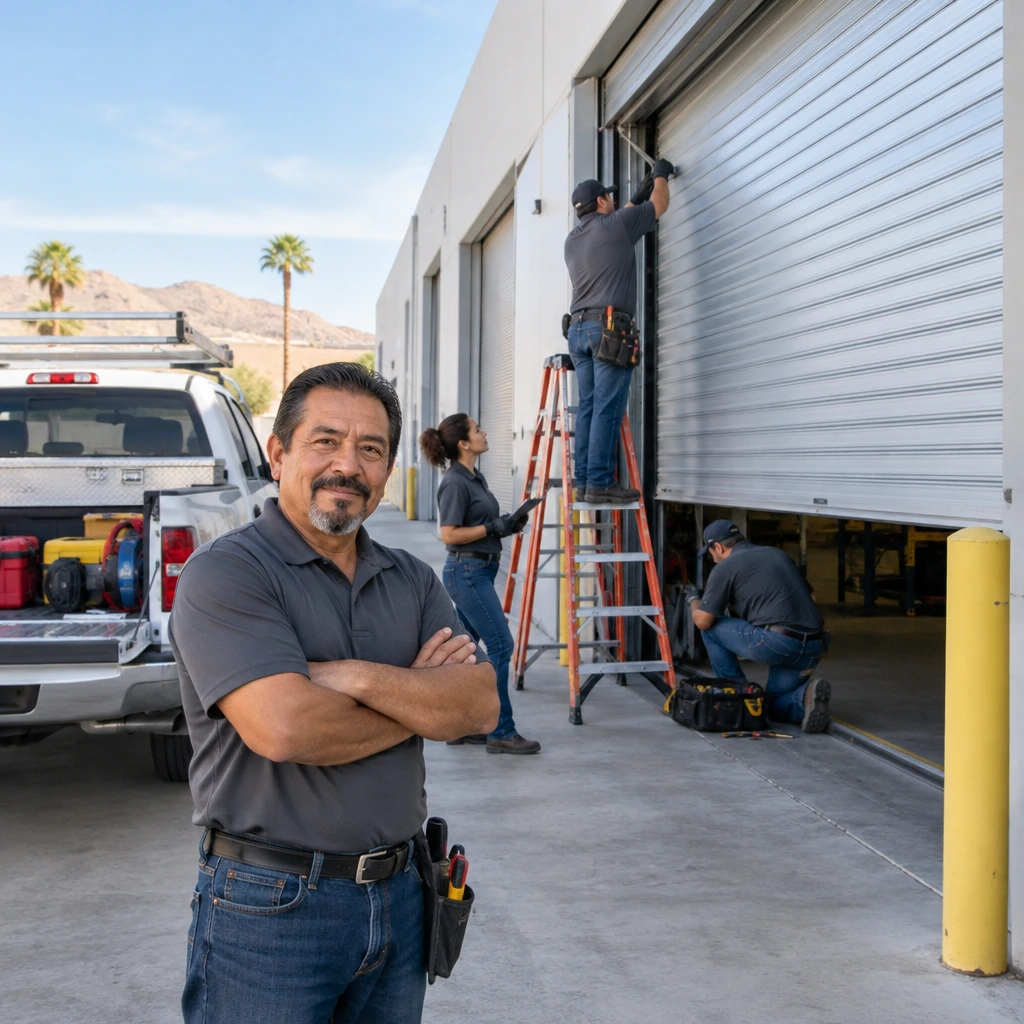
Incorrect measurements can lead to rubbing, uneven movement, excessive gaps, limited clearance, or premature component failure. A professional site assessment confirms the opening dimensions and identifies obstacles such as beams, electrical equipment, ductwork, shelving, piping, or inadequate side room.
Arizona Roll Up Door Service provides custom measurements, installation planning, safety testing, and recommendations based on the property’s use. The team also maintains an inventory of replacement parts, helping support same-visit repairs when possible and minimizing disruption to Phoenix-area businesses.
Maintenance Protects Your Roll Up Door Investment
Even the correct roll up door thickness cannot compensate for poor maintenance. Springs lose tension, tracks collect dust, hardware loosens, seals wear, and operators can become strained over time. Phoenix dust and heat can make regular inspections particularly valuable for commercial facilities.
Preventive maintenance should include lubrication of appropriate moving parts, spring and cable tension inspections, track cleaning, alignment checks, hardware tightening, safety sensor testing, and performance evaluation. Businesses should also watch for warning signs such as:
- Slow, hesitant, or uneven operation
- Grinding, scraping, or unusual popping sounds
- A curtain that binds in the guides
- Visible damage to panels, slats, cables, or bottom hardware
- A door that reverses unexpectedly or fails to close fully
- An opener that strains, stops, or requires repeated commands
Do not attempt to adjust high-tension springs or cables without proper training. These components can store significant energy and should be inspected and replaced by qualified professionals. Prompt service can help prevent a minor alignment or lubrication issue from becoming an emergency closure.
Conclusion: Get the Right Commercial Roll Up Door for Your Phoenix Business
The best roll up door thickness depends on more than a number on a product sheet. Your decision should account for opening size, daily cycles, impact risk, wind exposure, insulation needs, security goals, available clearance, and long-term maintenance. In Phoenix, intense heat and extended periods of extreme temperatures make dependable materials, proper seals, and professional installation especially important.
Arizona Roll Up Door Service has over 20 years of experience helping businesses throughout Phoenix, Avondale, Buckeye, Goodyear, Scottsdale, North Phoenix, and the surrounding metro area. From new commercial roll up door installation to fast repairs and customized maintenance programs, the team focuses on quality craftsmanship, competitive pricing, and minimal business downtime.
Contact Arizona Roll Up Door Service today for a free consultation. Let us evaluate your opening, explain your options, and help keep your facility secure, efficient, and functional.