For a warehouse, loading area, restaurant, retail center, or industrial facility, a fire-rated roll-up door is more than a security feature. It is part of the building’s life-safety system. In 2026, Phoenix businesses must pay close attention to the relationship between the 2025 edition of NFPA 80, the locally adopted 2024 Phoenix Fire Code, and the door manufacturer’s listing and installation instructions. A door that opens and closes every day may still fail an inspection if its automatic closing system, fusible links, guides, counterbalance, release device, or documentation is neglected.
This guide explains Phoenix, AZ roll-up door fire-code compliance, including annual inspection expectations, installation considerations, maintenance records, and common problems that can place a commercial property out of compliance. It is intended as practical educational information—not a substitute for project-specific review by the Phoenix Fire Department, building officials, or the authority having jurisdiction (AHJ).
Phoenix, AZ Roll-Up Door Fire-Code Compliance in 2026
The local starting point is the City of Phoenix Fire Code. Phoenix lists the 2024 International Fire Code with Phoenix amendments as effective February 17, 2026. The city also provides a 2026 explanatory policy manual and directs code questions to the Phoenix Fire Department’s Fire Prevention Section. You can review the current materials through the City of Phoenix Fire Code page.
For Phoenix properties, NFPA 80 is generally the key referenced standard for fire doors and other opening protectives. NFPA’s current available publication listing identifies the 2025 edition of NFPA 80. The standard addresses subjects such as installation, acceptance testing, inspection, testing, maintenance, and rolling fire door systems. However, the edition that applies to a particular building or project can depend on the locally adopted code, permit documents, construction date, existing-building provisions, and direction from the AHJ.
That distinction matters. Saying that a door is “NFPA 80 compliant” is not enough by itself. A compliant installation must typically include all of the following:
- A listed and properly rated fire door assembly suitable for the opening and wall construction.
- Installation according to the manufacturer’s instructions and approved construction documents.
- Automatic closing or release features that operate as intended during a fire event.
- Clearance around the opening so the curtain can descend without obstruction.
- Inspection, testing, maintenance, and documentation at the required intervals.
- Repairs using compatible components that do not compromise the listing.
In practical terms, NFPA 80 compliance in Phoenix is not just a product-selection issue. It is an ongoing operational responsibility for the building owner, facility manager, and service provider.
How the 2026 Phoenix code update affects businesses
The City of Phoenix adopted its 2024 Building Construction Code in 2025, with an August 1, 2025 effective date for building-code implementation. The fire-code page separately identifies February 17, 2026 as the effective date for the adopted 2024 Phoenix Fire Code and amendment packet. Projects already in progress may be handled under transition or permit provisions, so owners should confirm the governing requirements for their specific project.
For a new Phoenix fire-rated door installation, the plans should identify the opening’s required rating, wall assembly, door listing, release method, controls, and testing requirements. For an existing door, the goal is usually to verify that the assembly remains operable and that alterations or repairs have not removed required protection.
Annual Inspection and Testing Requirements for Phoenix Fire-Rated Roll-Up Doors
One of the most important 2026 requirements is the expectation for recurring inspection and testing. A Phoenix Fire Department compliance forum presentation identifies a local requirement that rolling fire doors be inspected, tested, and reset annually by a trained fire door systems technician, with inspection and testing records maintained. The presentation also describes annual testing to confirm proper operation and full closure.
This is consistent with the broader fire-safety principle that a protective opening must remain in operative condition—not simply look intact during a walk-through. A door may appear serviceable while having a disconnected release cable, excessive curtain friction, a damaged guide, an inoperative alarm interface, or a failed automatic closing mechanism.
What an annual test should evaluate
A qualified inspection should be tailored to the door’s design, listing, and release arrangement. Depending on the assembly, the technician may evaluate:
- Full opening and closing movement.
- Automatic closing after activation of the release mechanism.
- Complete closure without binding, stopping, or excessive impact.
- Fusible links, heat-responsive devices, or other release components.
- Smoke or fire alarm interface, where the door is connected to those systems.
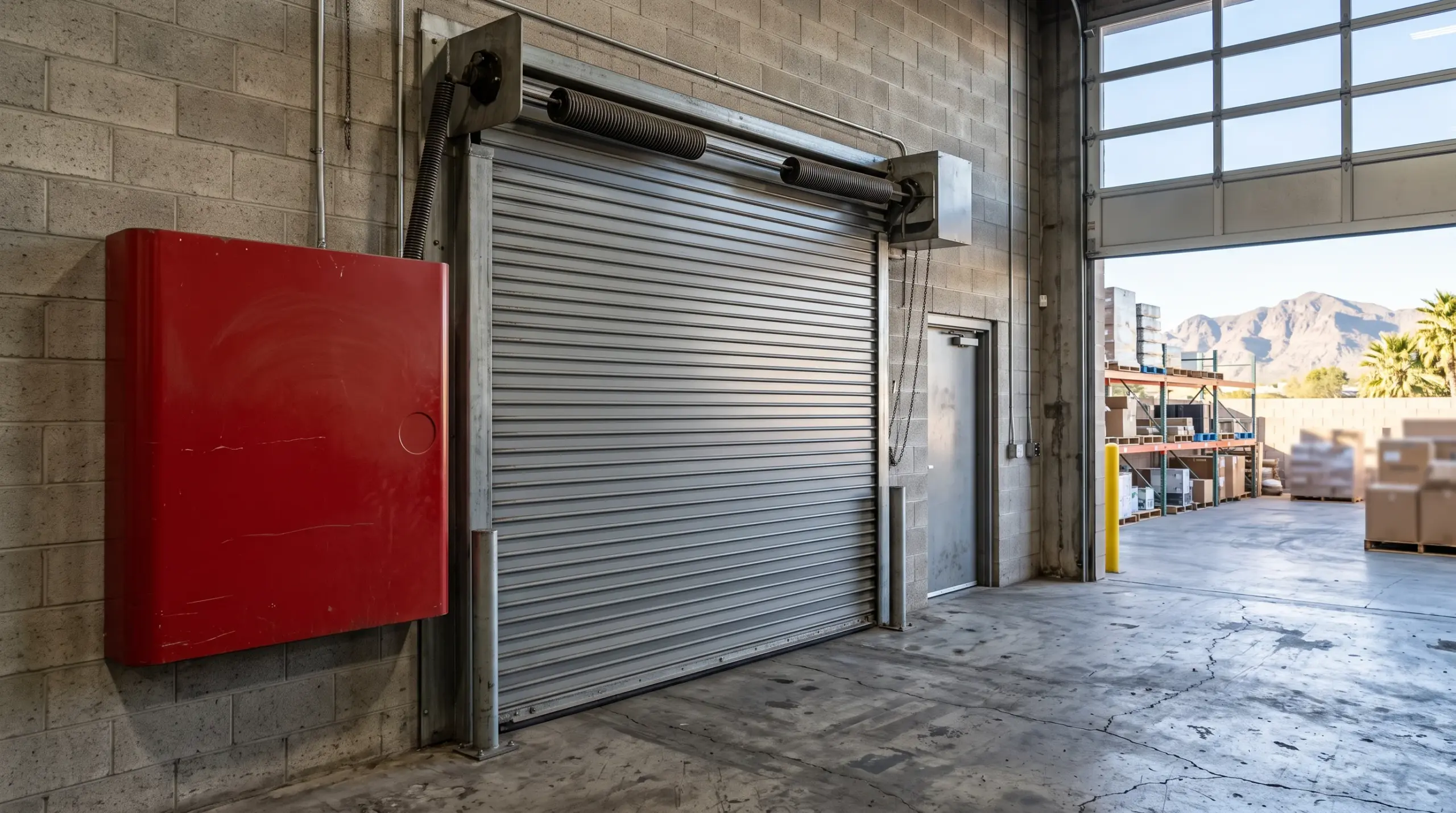
- Guides, brackets, curtain, bottom bar, hood, shaft, and operating hardware.
- Reset procedures after testing.
- Warning labels, inspection marks, and access to service components.
The test should be documented in a way that allows the owner and AHJ to determine what was inspected, when it was tested, who performed the work, what deficiencies were found, and whether corrective work was completed. The Phoenix Fire Department’s published compliance material specifically emphasizes record retention.
Why technician training matters
NFPA materials explain that rolling fire doors have multiple components that must work together for the assembly to test and reset correctly. A 2024 NFPA Tentative Interim Amendment for the 2025 edition describes a “trained rolling” fire door systems technician as someone with documented training and experience in inspection, testing, and maintenance. It also states that training should cover inspection, testing, maintenance, and safety procedures.
That is important because these doors can contain stored energy and may descend unexpectedly if components are disturbed. Facility employees can perform basic visual checks, but adjustment, release testing, counterbalance work, and repairs should be assigned to personnel with appropriate training and equipment.
Commercial Door Fire Code Requirements for Phoenix Facilities
Fire-rated roll-up doors are installed to protect openings in rated walls or separations. They may be used between a warehouse and a production space, at a loading area, near a hazardous-use room, or in other locations where the opening must limit the spread of fire. The required rating and configuration are not automatically determined by the door size alone.
The design professional and AHJ may consider the wall rating, occupancy, opening location, exposure, adjacent spaces, and whether the opening is part of a fire barrier, fire wall, or other rated assembly. The door assembly must be appropriately listed for that application, and the surrounding construction must support the intended protection.
Installation details that commonly affect compliance
A Phoenix fire-rated door installation should begin with accurate field measurements and a review of the approved plans. Important details include the clear opening, headroom, side-room, mounting surface, guides, hood, operator location, power supply, and release connections. The installation team should also confirm that the door does not conflict with sprinklers, exit routes, ventilation equipment, storage racks, or other building systems.
Common installation and maintenance issues include:
- Obstructions stored beneath or beside the opening.
- Guides that are bent, loose, dirty, or out of alignment.
- A curtain that rubs against the guides or does not descend evenly.
- Improper field modifications to the curtain, guides, hood, or release system.
- Missing or damaged labels and operating instructions.
- Controls that prevent automatic closure or interfere with reset.
- Unapproved replacement components.
Do not wedge a normally closed fire door open, tie back a curtain, remove a release device, or bypass a safety feature to keep production moving. If the door must remain open temporarily because it is defective, ask a qualified professional and the AHJ what interim protection is required.
Fire-rated does not mean maintenance-free
Arizona’s heat, dust, wind, and high daily usage can accelerate wear at commercial openings. Dust and debris can affect guides and moving parts, while repeated vehicle traffic can damage bottom bars, tracks, photo eyes, and wall-mounted controls. Regular maintenance is therefore part of both reliability and warehouse roll-up door safety standards.
Preventative service should include lubrication where permitted by the manufacturer, hardware tightening, guide cleaning, alignment checks, spring and cable inspections, operator evaluation, and safety-device testing. Maintenance should never alter the door’s listed configuration without a documented, approved basis.
Local Considerations for Phoenix, AZ Warehouses and Commercial Properties
Phoenix, AZ facilities often combine high-volume loading operations, large exterior openings, dust exposure, and tight delivery schedules. In the West Valley, businesses in Avondale, Buckeye, and Goodyear may operate distribution, manufacturing, storage, or service facilities with multiple commercial openings. Scottsdale and North Phoenix properties may have mixed-use facilities, retail service areas, and multi-tenant buildings where fire-rated openings separate tenant spaces or service zones.
Regardless of the neighborhood, the operational risk is similar: a door that is slow, damaged, or left open can compromise security and disrupt inspections. A sluggish door may indicate poor lubrication, guide misalignment, worn hardware, an operator problem, or an issue with the counterbalance system. A broken spring or cable assembly can also create a dangerous condition and should not be handled as a do-it-yourself repair.
A practical Phoenix compliance checklist
- Identify every fire-rated opening. Record the location, door type, rating information, manufacturer, and service history.
- Review current documents. Keep permits, approved plans, product data, inspection forms, repair invoices, and prior deficiency reports together.
- Schedule annual testing. Use a trained fire door systems technician familiar with NFPA 80 and the specific door design.
- Keep the opening clear. Remove pallets, equipment, shelving, trash, and stored materials that could obstruct closure.
- Correct deficiencies promptly. A door that does not fully close, release, or reset should be evaluated without delay.
- Coordinate with the AHJ when needed. Phoenix provides a formal fire-prevention appeals process for certain code modifications or questions.
Owners should also remember that city requirements are only one part of the compliance picture. Insurance carriers, landlords, fire protection contractors, design professionals, and corporate safety programs may impose additional inspection or documentation requirements.
Repair and Maintenance Services That Support NFPA 80 Compliance
When a commercial fire-rated roll-up door fails a test, the repair should address the cause—not merely make the door move temporarily. Arizona Roll Up Door Service provides commercial installation, repair, and maintenance throughout Phoenix, AZ and the surrounding metro area, including Avondale, Buckeye, Goodyear, Scottsdale, and North Phoenix.
Service may include diagnosis of slow operation, guide alignment, obstruction removal, motor and opener problems, damaged panels or sections, broken springs and cable assemblies, and safety-device concerns. A professional evaluation can also determine whether a component is repairable or whether replacement is necessary to preserve the door assembly’s intended function.
For facility managers, a preventative maintenance schedule can reduce emergency downtime and help create a consistent inspection trail. Depending on traffic and operating conditions, the schedule may include monthly visual checks by staff, periodic professional maintenance, and the required annual fire-door inspection and test.
With more than 20 years of experience, Arizona Roll Up Door Service focuses on commercial doors, prompt response, quality workmanship, and practical solutions. Fully stocked replacement parts may allow many repairs to be completed during the same visit when the correct component is available and the repair is appropriate.
Conclusion: Prepare for 2026 NFPA 80 Compliance in Phoenix
Phoenix, AZ roll-up door fire-code compliance depends on more than installing a rated product. The assembly must be correctly selected, properly installed, kept clear, tested annually, maintained in working condition, and supported by accurate records. Under the current Phoenix framework, businesses should pay particular attention to annual inspection, testing, full closure, reset procedures, and the qualifications of the technician performing the work.
If your commercial property has a fire-rated roll-up door that is slow, damaged, difficult to reset, or overdue for inspection, schedule an evaluation before the next fire inspection or operational disruption. Arizona Roll Up Door Service serves the entire Phoenix metro area with expert installation, repair, and maintenance. Contact Arizona Roll Up Door Service today for a free consultation and dependable support for your facility’s commercial door needs.