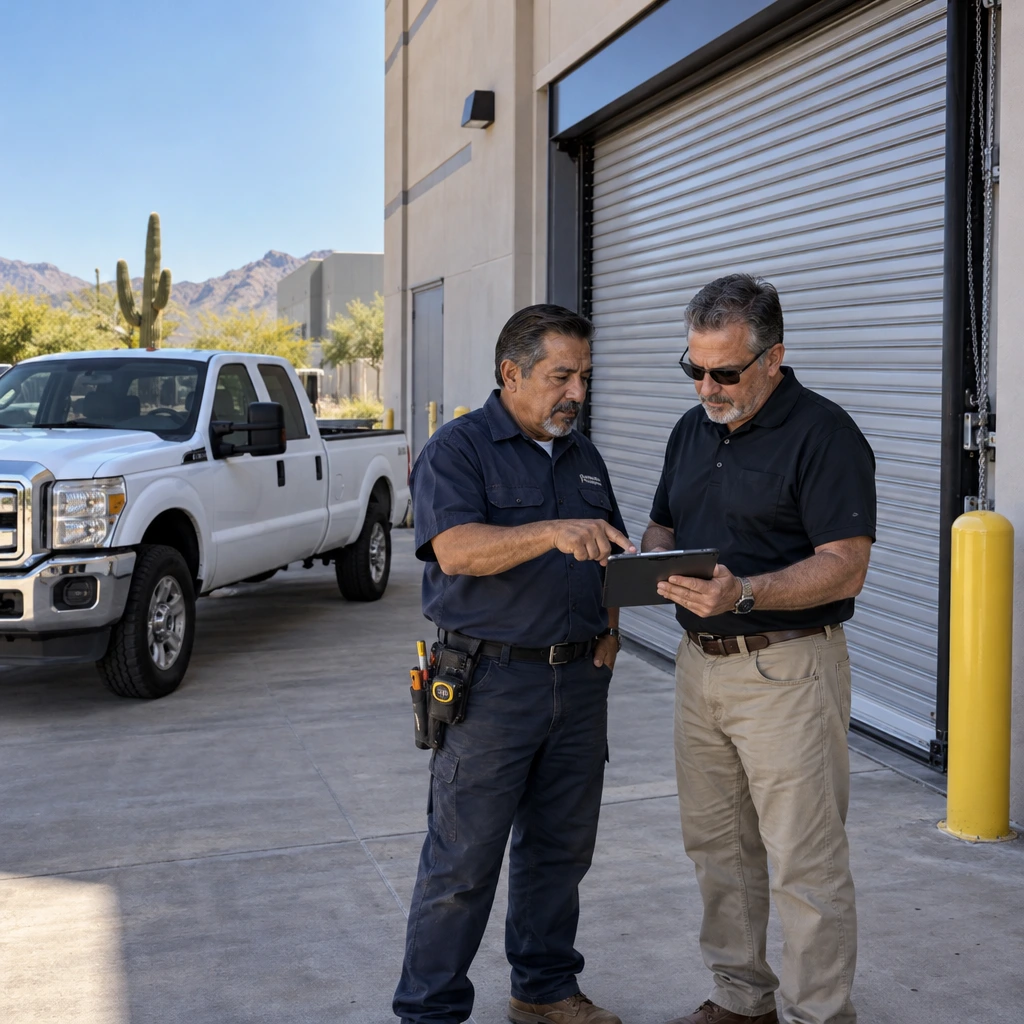
If you manage a warehouse, distribution center, or commercial facility in Phoenix, a malfunctioning roll up door can bring operations to a standstill. Whether it’s a broken spring that leaves the door stuck halfway, a damaged motor that won’t respond, or bent slats blocking the opening, understanding repair costs before you need emergency service helps you budget smarter and avoid surprises. This guide breaks down what rolling steel door repairs typically cost in Phoenix during 2026, which factors push prices up or down, and how to decide when repair makes more sense than replacement.
We’ll walk through the most common problems Arizona businesses face—from spring failures in the summer heat to track misalignment caused by forklift impacts—and show you what each repair runs in real-world pricing. You’ll also learn how preventive maintenance can cut your long-term costs and keep your facility secure year-round.
Average Rolling Door Repair Cost Phoenix: What to Expect in 2026
Repair pricing for commercial roll up doors varies widely depending on the problem, door size, and service timing. According to published 2026 price guides, a typical rolling steel door repair in Phoenix falls between $300 and $900. That’s a national benchmark, and local Phoenix pricing can shift based on your specific situation.
For smaller repairs—such as fixing a broken spring or replacing a single damaged panel—most jobs cost $250 to $600. These routine fixes are the most common calls and usually wrap up in a single visit when the technician carries the right parts. More involved work, like replacing track sections or repairing motor components, often runs $600 to $1,200. These projects take longer and require specialized parts, especially for commercial or industrial doors built for heavy daily cycles.
At the high end, full door replacement typically costs between $1,500 and $3,500, though larger or custom high-security doors can push past $5,000. Emergency service calls and extensive repairs—such as fixing major curtain damage or replacing an entire operator system after hours—may range from $1,000 to over $5,000 depending on scope and urgency.
Key Factors That Influence Repair Pricing
Several variables determine where your repair falls on the cost spectrum:
- Type of repair: Realigning a guide costs far less than replacing a torsion spring assembly or installing a new motor.
- Door size and weight: Large commercial openings need heavier-duty parts and more labor hours, driving up both material and service costs.
- Access and height: High-lift doors or awkward installation sites may require boom lifts or extra crew, adding to the total.
- Parts availability: Older or specialty doors sometimes need custom-fabricated components that take longer to source and cost more than off-the-shelf parts.
- Emergency timing: After-hours, weekend, and same-day emergency calls typically carry premium rates.
- Electrical work: Upgrades to operators, control panels, or automated systems add complexity and expense beyond mechanical repairs.
Always request a written, itemized estimate that separates parts, labor, and any trip or diagnostic charges. Transparency up front prevents billing surprises after the work is done.
Most Common Roll Up Door Problems and Repair Costs
Phoenix’s extreme heat, dust, and high commercial door usage create a predictable set of failure points. Here’s what breaks most often and what each fix typically costs.
Broken or Worn Torsion Springs
If your door feels unusually heavy, drops quickly when opening, or won’t stay up, the torsion spring has likely lost tension or snapped. Springs are under extreme force and fail more often in Arizona’s heat, which accelerates metal fatigue. Spring replacement is not a DIY job—the stored energy can cause serious injury if released improperly.
Professional spring replacement typically runs $300 to $700 depending on door size and spring type. High-cycle commercial springs rated for 25,000 to 100,000 cycles cost more than standard residential springs but last far longer under daily use. If the door is stuck open or shut, emergency spring service may add $100 to $300 to the base cost.
Motor and Operator Failures
Motorized roll up doors fail when the motor burns out, a limit switch drifts out of calibration, or a control board dies. Symptoms include humming without movement, stopping partway through the cycle, or reversing unexpectedly. A technician will test the operator, reset limit switches, and repair or replace faulty components.
Motor and automation repairs generally cost $400 to $1,200. Simple fixes like limit switch adjustments or sensor replacements fall on the lower end, while full motor or control board replacement pushes toward the higher range. For facilities with multiple automated doors, a preventive maintenance plan can catch early signs of motor wear before they become costly failures.
Bent or Damaged Curtain Slats
A single bent slat can bind the entire curtain and prevent smooth operation. Damage usually comes from forklift impacts, debris strikes, or forcing a jammed door. Fortunately, damaged slats are typically replaced individually rather than requiring a full curtain replacement.
Replacing one or two slats costs $150 to $400 depending on material and door size. If multiple slats are damaged or the curtain is badly corroded, replacing larger sections or the entire curtain may run $800 to $2,500. Inspect the rest of the door—if the barrel, guides, and frame are sound, sectional replacement is far more cost-effective than a new door.
Track Misalignment and Guide Damage
Impact from a vehicle, a bent guide, or debris buildup can knock the curtain out of alignment. Forcing the door when it binds only makes the problem worse and can bend slats or damage the barrel. A technician straightens or replaces the guides, resets the curtain, and checks the barrel for hidden damage.
Track realignment and guide repair typically cost $200 to $600. If the guides need full replacement or the barrel sustained damage, expect $500 to $1,000 or more. Regular track cleaning and prompt attention to minor binding prevent these more expensive repairs.
Safety Sensor and Limit Switch Issues
Misaligned safety edges, faulty photo eyes, or debris in the guides can stop the door short of the floor, leaving a security gap and blocking safety systems. Sensor problems are common in dusty Phoenix environments where fine particles coat the photo eyes.
Sensor alignment and replacement usually run $150 to $400. Limit switch adjustments are often included in routine service calls. If the door won’t close fully or reverses unexpectedly, start with a sensor inspection before assuming a more expensive motor or control issue.
Repair vs. Replacement: When Each Makes Financial Sense
Deciding whether to repair or replace a roll up door depends on the door’s age, condition, and cumulative repair history. Repair is usually the better value when the curtain is straight, the barrel is sound, and the problem is isolated to a spring, operator, seal, or a few slats. You’re investing in a door that still has years of service left.
Consider replacement when:
- Repairs are frequent and the cumulative cost over the past year or two approaches the price of a new door
- The curtain is badly bent, heavily corroded, or missing many slats
- The barrel, brackets, or guides are damaged beyond economical repair
- You need better insulation, security, or wind resistance than the current door provides
- Parts for an older door are hard to find or require long lead times
As a rule of thumb, if a single repair exceeds 50% of the replacement cost, or if you’re facing multiple major repairs within a short window, replacement often delivers better long-term value. A new commercial roll up door with modern insulation, high-cycle springs, and a reliable operator can pay for itself through reduced energy costs and fewer service calls over its 20- to 25-year lifespan.
The Hidden Cost of Downtime
For commercial facilities, the real cost of a broken door isn’t just the repair bill—it’s the lost productivity, delayed shipments, and security risks while the door is out of service. A stuck loading dock door can idle an entire shipping crew. A storefront door that won’t lock forces you to station security overnight or risk inventory loss.
When evaluating repair versus replacement, factor in how often the door fails and how much each failure costs your operation. A $3,000 door that runs reliably for 20 years is far cheaper than a $1,500 door that breaks down twice a year and costs you thousands in lost time and emergency service.
Preventive Maintenance: The Best Way to Control Long-Term Costs
Most roll up door failures are preventable. Phoenix’s heat and dust are hard on lubrication, seals, and moving parts, so routine service delivers measurable returns. A solid preventive maintenance schedule includes:
- Lubricating bearings, guides, rollers, and moving parts with high-temperature grease
- Inspecting springs, slats, brackets, and the barrel for wear or damage
- Testing safety edges, limit switches, and photo-eye sensors
- Clearing debris from guides, tracks, and thresholds
- Checking seals and bottom bars for heat damage or gaps
- Tightening hardware and adjusting spring tension as needed
Regular maintenance extends door life from 15 years to 25 years or more and prevents costly breakdowns. According to industry maintenance programs, quarterly inspections, lubrication, and part adjustments typically cost just $200 to $400 per year per door—a fraction of the cost of emergency repairs or premature replacement.
For businesses with multiple doors, a scheduled maintenance agreement ensures all doors receive consistent care and catches problems early. Fire-rated rolling doors have additional inspection and testing requirements, so confirm compliance with your local fire authority and schedule regular inspections to maintain your rating.
DIY Maintenance vs. Professional Service
Cleaning the guides, wiping down the curtain, and clearing debris are reasonable owner tasks. Anything involving springs, the barrel, the operator, or lifting the curtain should go to a professional. Roll up doors are heavy, and stored spring tension can cause serious injury if released improperly. Improper repairs also risk damaging the door, creating safety hazards, and voiding manufacturer warranties.
When in doubt, stop and call a qualified technician. The cost of a service call is always less than the cost of an injury or a door destroyed by a failed DIY repair.
Emergency Service: What to Do When Your Door Fails
Some failures can’t wait. A door stuck open overnight exposes your facility to theft and weather. A curtain jammed shut across a loading bay halts operations. A storefront door that won’t lock forces you to close early or station security.
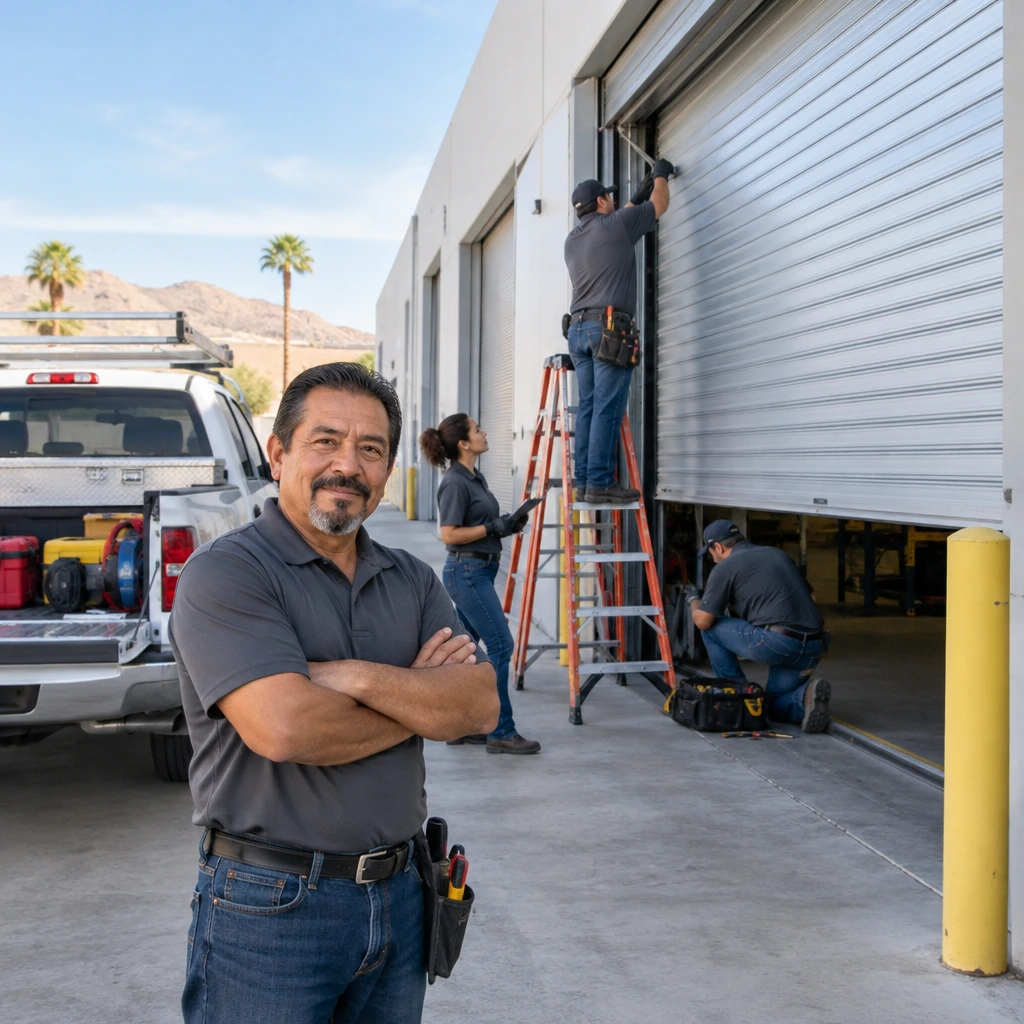
For urgent problems, Arizona Roll Up Door Service offers emergency 24-hour service throughout the Phoenix metro area, including Avondale, Buckeye, Goodyear, Scottsdale, and North Phoenix. Our service trucks are fully stocked with common commercial parts, so we can often complete repairs the same visit and get your facility back in operation quickly.
While you wait for service:
- Keep people and vehicles clear of the door
- Don’t force the door or attempt to manually lift a motorized door unless you’ve been trained
- Secure the opening if possible—use temporary barriers or station personnel if the door is stuck open
- Document the problem with photos for your service provider
Emergency calls typically carry premium rates, but the cost of same-day service is almost always less than the cost of extended downtime, lost inventory, or a security breach.
Choosing the Right Roll Up Door Repair Provider in Phoenix
Not all door companies are created equal. When selecting a repair provider, ask:
- Do they specialize in commercial and rolling steel doors, or do they primarily handle residential sectional doors?
- Can they handle springs, operators, and curtain repairs on site, or do they need to order parts and return later?
- Do they offer preventive maintenance plans as well as one-off repairs?
- Is pricing written, itemized, and provided before work begins?
- Do they serve your specific area within the Phoenix metro region?
Look for providers with at least 10 to 20 years of experience, a stocked service fleet, and a track record serving commercial clients. Check for proper licensing, insurance, and manufacturer certifications. A company that offers both repair and maintenance is more likely to keep your doors running long-term rather than just patching problems as they arise.
Budget Planning: How to Prepare for Roll Up Door Expenses
Smart budgeting for roll up door costs means planning for both routine maintenance and unexpected repairs. Here’s a practical approach:
Annual maintenance budget: Set aside $200 to $400 per door per year for scheduled preventive service. For a facility with four doors, that’s roughly $1,000 to $1,600 annually—a small investment that prevents far larger repair bills.
Repair reserve: Budget an additional $500 to $1,000 per door per year for unexpected repairs. Not every door will need it every year, but having the reserve prevents scrambling when a spring breaks or a motor fails.
Replacement planning: Commercial roll up doors typically last 15 to 25 years with proper maintenance. If your doors are approaching 15 years old, start setting aside funds for eventual replacement. A basic 10×10 commercial door starts around $2,500 installed, while large insulated doors with premium operators can run $5,000 to $8,000. Spreading that cost over several years makes replacement manageable rather than a budget crisis.
Energy savings: Insulated commercial roll up doors can cut HVAC costs by 15% to 30%, saving $500 to $1,200 per year for typical warehouse doors. If you’re replacing an uninsulated door, the energy savings alone can pay back the upgrade cost in three to five years.
Protect Your Investment with Arizona Roll Up Door Service
Understanding roll up door repair costs in Phoenix helps you make informed decisions, avoid unnecessary expenses, and keep your facility secure and operational. Whether you’re facing a broken spring, a damaged curtain, or a motor that won’t respond, knowing what repairs should cost and when replacement makes more sense puts you in control.
Arizona Roll Up Door Service has served the Phoenix metro area for over 20 years, providing expert installation, repair, and maintenance for commercial and residential roll up doors. We offer transparent pricing with no hidden costs, same-day service when possible, and preventive maintenance programs that extend door life and reduce emergency repairs. Our fully stocked service trucks and experienced technicians mean we can handle most repairs in a single visit, minimizing your downtime.
Don’t wait until a broken door shuts down your operation. Contact Arizona Roll Up Door Service today for a free consultation and written estimate. Let us help keep your facility secure, functional, and running smoothly year-round.