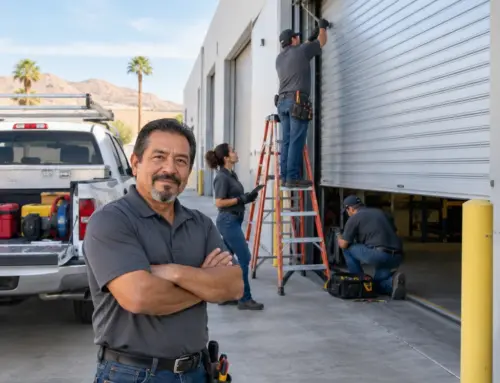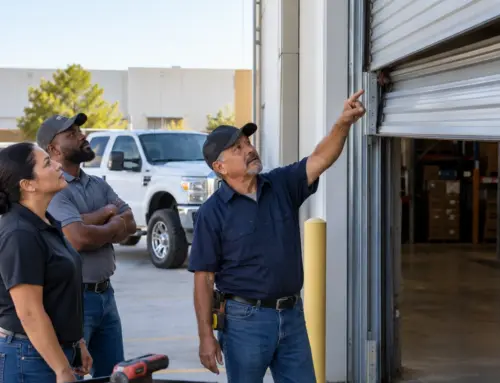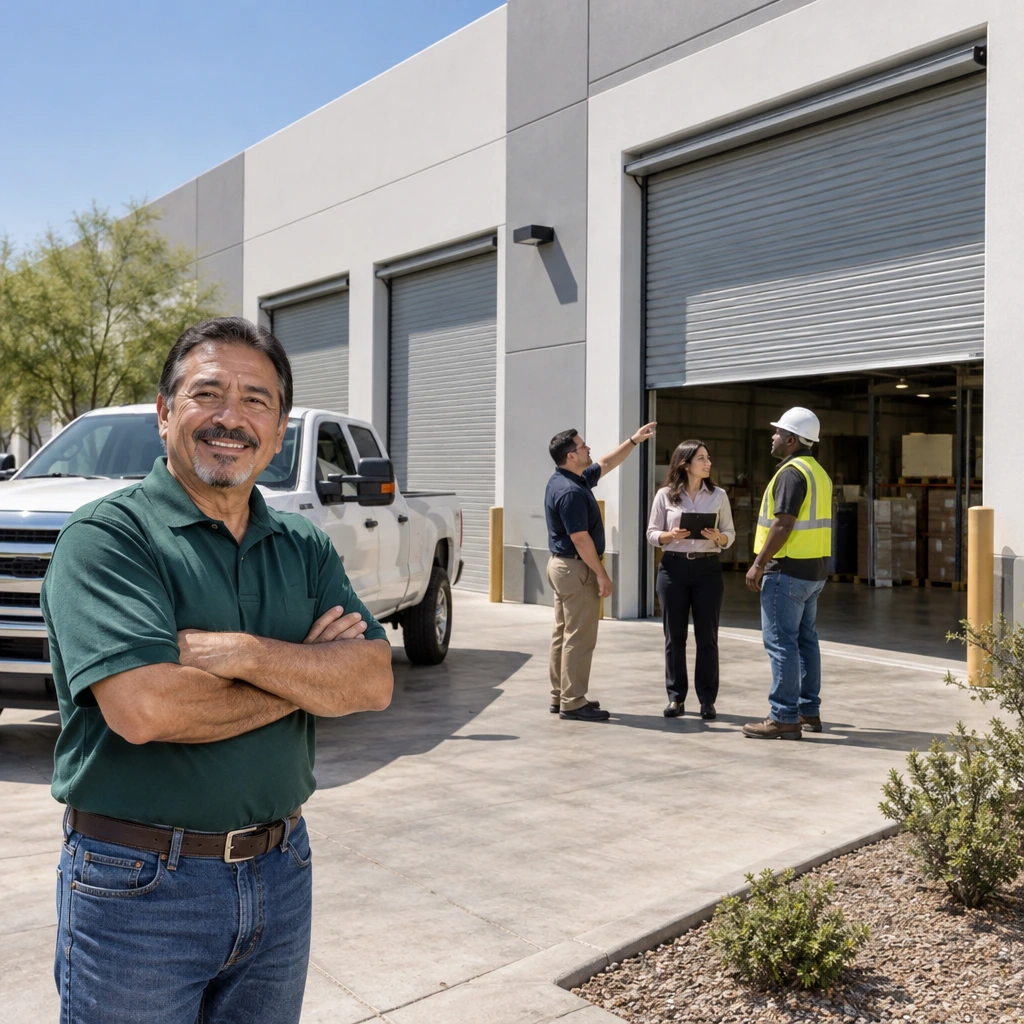
Roll-up door alignment problems can start with a small change—a guide shifting, a pipe shaft settling, or debris building up in one track—and quickly become a costly interruption for a business. When the curtain begins rubbing, the door moves unevenly, or the operator strains during each cycle, the issue is often more than simple wear. Poor alignment can damage guides, bearings, panels, springs, and the motor if it is ignored. This guide explains practical DIY checks that owners and facility managers can safely perform, the warning signs that require a professional, and what a proper door realignment service should include. You will also learn how regular commercial door maintenance can help prevent recurring track problems on roll-up doors throughout Phoenix, Avondale, Buckeye, Goodyear, Scottsdale, and North Phoenix.
Roll-Up Door Alignment Problems: What They Look Like
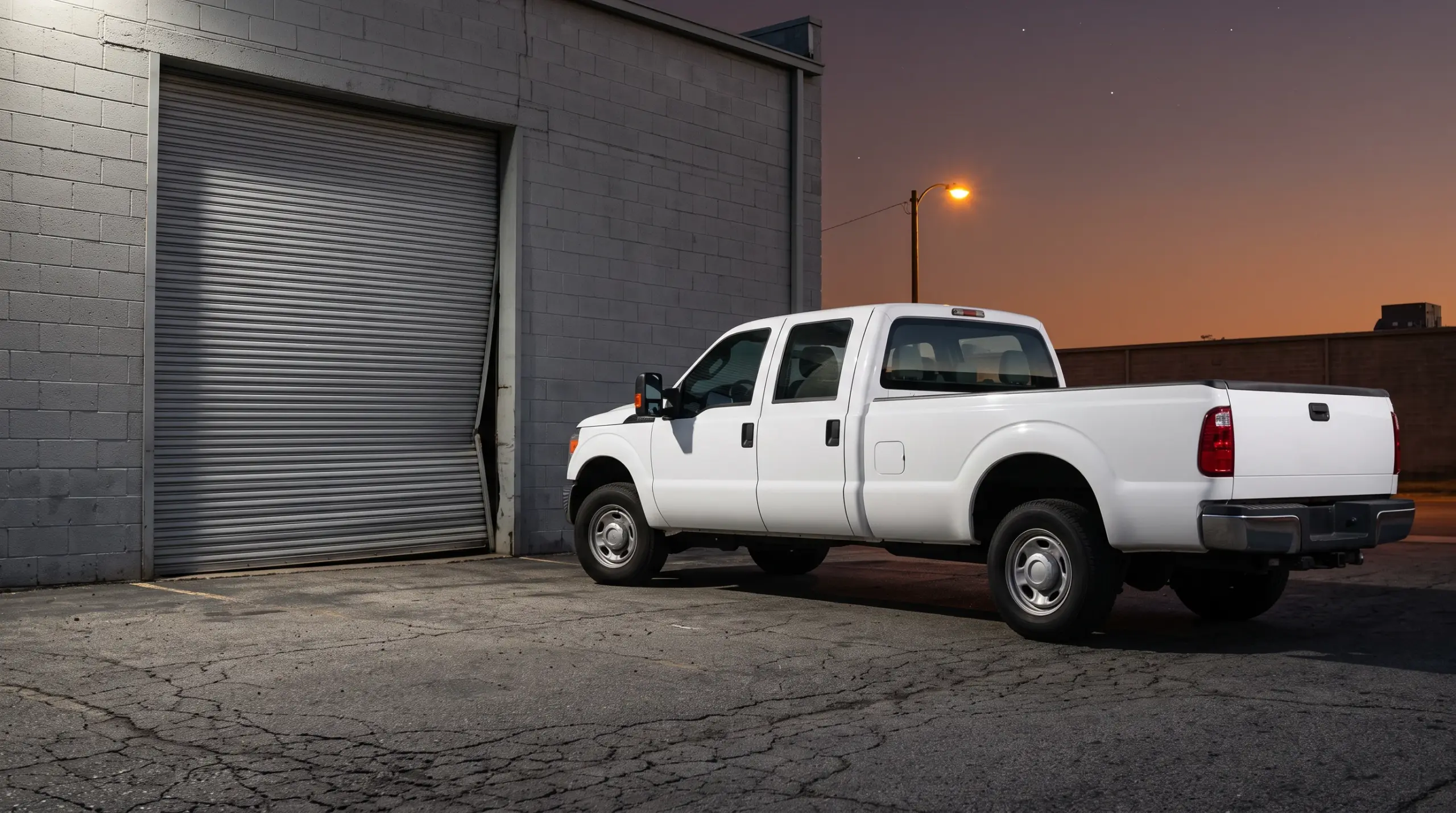
A properly aligned roll-up door should travel smoothly, remain centered between its guides, and respond consistently from the fully closed position to the fully open position. Alignment problems usually appear as changes in sound, speed, movement, or clearance. Because the door’s curtain, guides, shaft, and operating equipment work together, a problem in one area can create symptoms somewhere else.
Common warning signs
- The curtain rubs against one guide or appears closer to one side.
- The door rises or lowers at an angle instead of moving evenly.
- There is binding, scraping, popping, or unusually loud operation.
- The door stops partway, reverses unexpectedly, or requires repeated cycles.
- Panels, slats, guide edges, or fasteners show fresh wear marks.
- The motor sounds strained or the operator runs longer than usual.
- The bottom bar does not meet the floor evenly.
In its guidance on common installation problems, the Door and Access Systems Manufacturers Association, or DASMA, emphasizes that the opening should be square, the guides should be plumb and true, and the barrel assembly should be level. These are not merely installation details. They are the basic geometry that keeps a commercial roll-up door centered during operation. See the DASMA overview of common rolling door installation problems for additional technical context.
In Phoenix, heat, dust, frequent cycling, vehicle impact, and building movement can make alignment symptoms more noticeable. However, a door that suddenly becomes crooked or difficult to operate should not be blamed on Arizona conditions alone. A professional inspection can determine whether the cause is track alignment, a damaged guide, uneven mounting, spring tension, a bent panel, or a structural issue around the opening.
Safe DIY Checks for Track Problems on Roll-Up Doors
Owners and employees can perform a visual and operational inspection, provided they stay away from components under tension and do not remove covers or loosen structural fasteners. The goal is to document symptoms—not to force the door back into position.
Start with a visual inspection
With the door stopped and the operating area clear, inspect both vertical guides from top to bottom. Look for dirt, loose hardware, dents, bent edges, or objects that may be restricting the curtain. Check whether the guides appear parallel and whether the visible gaps between the curtain and guides look reasonably consistent on both sides.
Next, examine the opening itself. A settling wall, damaged jamb, or impact near the bottom of a guide can change the door’s path. Look for cracked masonry, shifted mounting angles, or fasteners that no longer sit tight. Do not attempt to correct those conditions with improvised shims or by striking the guide with a hammer.
Observe several complete cycles
If the door can operate safely, watch it open and close from a safe position without standing beneath the moving curtain. Note exactly when the problem occurs. Does the door bind near the floor, halfway up, or near the top? Does one side move first? Does the noise happen only while opening? These details help a technician distinguish between a guide issue, uneven balance, a shaft problem, or an operator setting.
For powered doors, follow the manufacturer’s operating instructions and keep people, vehicles, and stored materials outside the travel area. OSHA stresses that exit routes must remain unobstructed and that workplace safety systems should be tested and repaired as needed. That principle applies directly to commercial access points used by employees, deliveries, and emergency personnel. Review OSHA’s workplace guidance on unobstructed exit routes and safety systems when evaluating a door that affects building access.
Simple DIY checks may include:
- Removing loose dust, leaves, packaging, or other visible obstructions near the guides.
- Checking for obvious impact damage without disassembling the guide system.
- Confirming that the door’s travel area is clear.
- Listening for new scraping, grinding, or repeated motor cycling.
- Taking photographs of uneven gaps, wear marks, and damaged components.
Do not adjust spring tension, remove a shaft, loosen bearing plates, reposition the curtain, or change operator limits as a DIY alignment project. DASMA’s TDS #270 warns that counterbalance assemblies and related parts are under extreme spring tension and should be serviced by a trained door systems technician using proper tools. Its maintenance guidance also recommends periodic inspection and maintenance at least annually, or according to the manufacturer’s instructions. Read the DASMA recommended rolling door maintenance practices for the safety boundary between inspection and repair.
When Professional Realignment Is the Safer Choice
A professional door realignment service becomes necessary when the door is visibly skewed, binds during travel, has damaged guides, or continues to malfunction after obvious debris is removed. Alignment is not simply a matter of making both tracks “look straight.” A technician must evaluate the relationship between the opening, guides, shaft, curtain, counterbalance, operator, and limit settings.
Situations that should not be handled alone
- Broken springs, cables, or counterbalance components.
- A door that has dropped, jumped out of a guide, or become stuck overhead.
- Loose or shifting headplates, brackets, shafts, or bearing supports.
- Severe panel damage or a curtain that is folded, bent, or off-center.
- Repeated motor overloads, blown fuses, or operator faults.
- Fire-rated equipment or any door connected to a life-safety system.
- Structural movement, damaged jambs, or an opening that is no longer square.
Improper adjustments can create a second problem while appearing to solve the first. For example, forcing a guide inward may reduce visible clearance on one side but cause the curtain to rub more severely as it rolls upward. Changing limit settings may make the door stop at a different height without correcting the underlying alignment. Adding lubricant to a dirty or damaged guide may temporarily quiet the noise while allowing wear to continue.
DASMA’s Winter 2024 technical article identifies an out-of-level pipe shaft as a source of binding, noise, curtain movement, and premature wear. The same article recommends precise inspection tools, including level equipment and gauges, to verify that guides are parallel, perpendicular to the floor, and correctly spaced. Those measurements are difficult to make reliably with a quick visual check, particularly on a large commercial opening.
What a qualified technician should evaluate
A professional inspection should identify the root cause before realignment begins. Depending on the symptoms, the technician may check guide spacing, guide plumb, shaft level, curtain centering, opening dimensions, bracket condition, spring balance, panel condition, operator limits, and safety devices. The technician should also look for signs that the building opening itself has shifted.
For businesses searching for misaligned commercial doors in Phoenix, the right service provider should explain what caused the misalignment and what work is actually needed. A responsible repair may include obstruction removal, hardware tightening, guide adjustment, panel repair, shaft correction, operator testing, or replacement of damaged parts. It should not rely on repeated force or temporary shortcuts.
How Commercial Door Maintenance Prevents Realignment Issues
Alignment is easier to preserve than to restore. A planned commercial door maintenance program can identify loose hardware, dirt accumulation, uneven wear, lubrication needs, and safety problems before the door stops working during a busy delivery or production period.
Preventative service should be based on the door’s use, environment, and manufacturer recommendations. A high-cycle opening at a warehouse may need more frequent attention than a lightly used service opening. Arizona dust and heat also make cleaning and inspection especially important, since contamination can increase friction and hide early wear.
A practical maintenance checklist
- Inspect both guides for plumb, parallel alignment, damage, and obstructions.
- Check mounting hardware, brackets, fasteners, and visible support points.
- Examine the curtain, bottom bar, panels, rollers, and guide contact surfaces.
- Listen for changes in noise, speed, balance, and stopping position.
- Lubricate only the components and locations specified by the manufacturer.
- Test safety sensors, reversing functions, emergency controls, and warning devices where applicable.
- Record defects and schedule repairs before they become operational failures.
Over-lubrication is not a substitute for cleaning or alignment. DASMA’s recent installation guidance notes that inadequate lubrication can increase friction, wear, energy consumption, and maintenance costs, while excess lubricant can attract dirt and debris. The correct product, amount, and application point matter.
Maintenance records are also valuable for facility managers. Documenting the date, symptoms, measurements, parts replaced, and safety tests performed helps reveal recurring problems. If a door requires realignment several times, the underlying issue may involve the structure, an impact-prone traffic pattern, improper installation, or a component that is reaching the end of its service life.
Choosing a Roll-Up Door Realignment Service in Phoenix
When alignment affects business access, response time matters. Arizona Roll Up Door Service has more than 20 years of experience helping commercial and residential customers throughout the Phoenix metro area, with a primary focus on commercial doors. Service includes track alignment and obstruction removal, sluggish-operation repairs, spring and cable assembly replacement, panel repairs, motor and opener diagnosis, safety sensor work, and preventative maintenance.
Before approving the work, ask a few direct questions:
- What caused the alignment problem?
- Are the guides, shaft, opening, and curtain all being inspected?
- Will damaged hardware or panels be repaired or replaced?
- Will the door be tested through multiple complete cycles?
- Will safety equipment and operator settings be checked?
- Are replacement parts available for a same-visit repair when possible?
A qualified local team should prioritize safe operation, clear communication, and durable repairs rather than simply getting the door moving for a few minutes. Arizona Roll Up Door Service serves Avondale, Buckeye, Goodyear, Scottsdale, North Phoenix, Central Phoenix, and surrounding communities. With stocked replacement parts and rapid service response when possible, the goal is to reduce downtime while restoring dependable operation.
Conclusion: Fix Alignment Problems Before They Become Downtime
Roll-up door alignment problems should never be ignored, especially on a commercial opening that employees, customers, and delivery vehicles use every day. A safe visual inspection can reveal debris, uneven gaps, damage, or new operating sounds. However, spring tension, shaft supports, guides, operator limits, and structural alignment require professional evaluation.
Regular commercial door maintenance helps protect the door’s performance and can reduce emergency repair costs. If your door is scraping, binding, leaning, stopping early, or placing unusual strain on the motor, contact Arizona Roll Up Door Service for prompt, professional service. With over 20 years of experience and coverage across the Phoenix metro region, the team can help keep your facility secure, functional, and ready for daily operations. Contact Arizona Roll Up Door Service today for a free consultation or schedule a door realignment service before a minor track problem becomes a major interruption.